
If you’re in Austin, termites are one of those “not fun, but very real” topics—right up there with surprise hail and running out of queso. And if you’re researching termite control in Austin, you’ll quickly notice there’s a lot of jargon mixed in with the sales pitches.
And once you start shopping for termite protection, you’ll hear three terms tossed around like they’re the same thing:
- Termite warranty
- Termite bond
- Termite service plan
They can feel similar. They’re not.
This guide breaks down what each one usually means, what to watch for in the fine print, and how to compare options without getting snowed by buzzwords.
We provide expert termite control across Austin, Dripping Springs, Bee Cave, Lakeway, Round Rock, Buda, and Kyle. Protect your home today!
Quick definitions (so you know what you’re buying)
Termite warranty
Think of a termite warranty as the “what happens if termites come back?” part of the agreement. It’s typically tied to a specific treatment and spells out what the company will do if there’s a new issue during the coverage period.
What to look for:
- What triggers service (signs of activity, confirmed infestation, damage, etc.)
- What the company will do (retreat, spot treat, or something else)
- Any limits (areas excluded, access rules, or special conditions)
Termite bond
In everyday conversation, “bond” often gets used as a shorthand for a termite agreement that stays active over time.
Here’s the truth, Austin-style: the label matters less than the written terms. Some “bonds” are basically a retreat warranty with renewals. Others can include repair coverage. A few are mostly inspection + maintenance.
So don’t shop the word. Shop the details.
Termite service plan
A service plan is the “stay ahead of trouble” option. It’s typically an ongoing program that can include inspections, monitoring, and preventive touch-ups depending on the plan.
Service plans are popular for:
- Homeowners who want ongoing checkups
- Landlords and property managers who want a repeatable routine
- Anyone who’d rather catch problems early than deal with a bigger mess later
What these agreements usually include (and what they don’t)
No two companies write agreements the same way—so the goal is to compare apples to apples.
Coverage types you’ll see
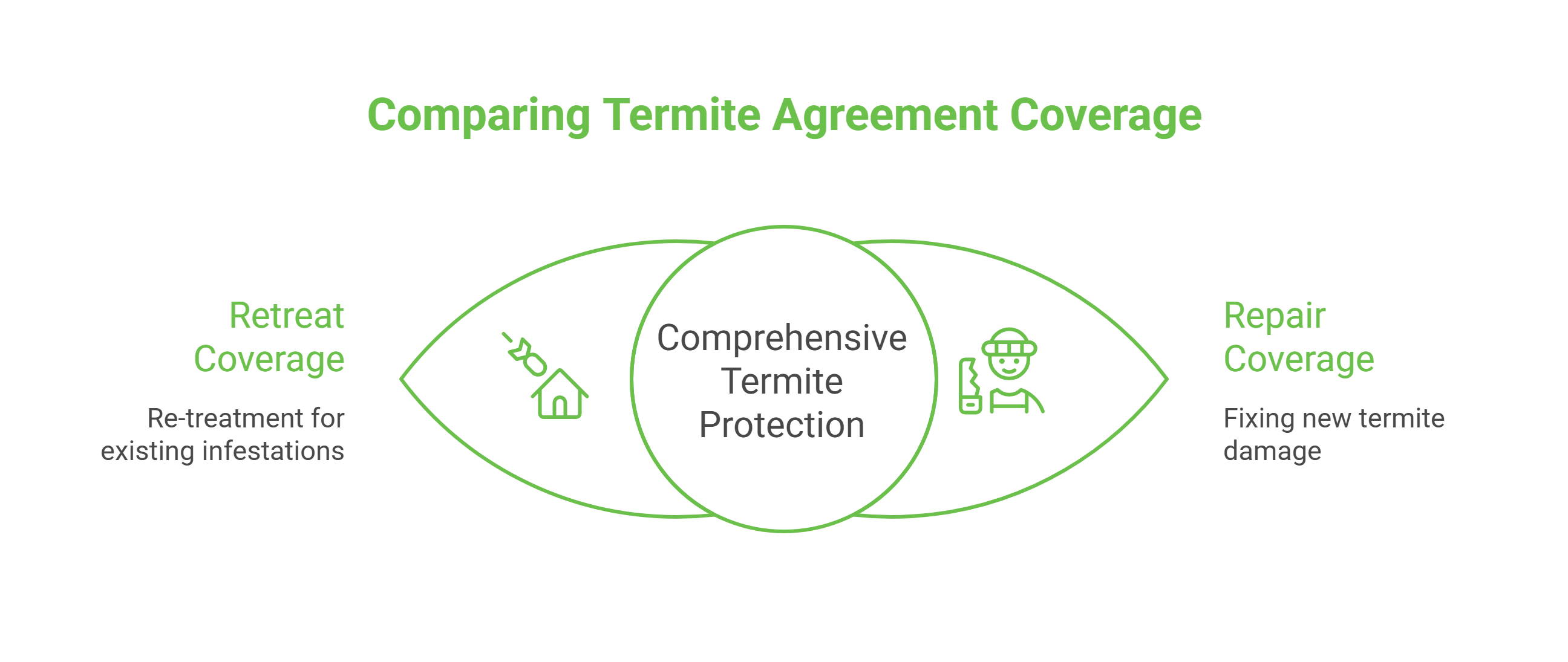
Most agreements fall into one of these buckets:
- Retreat coverage
- If termites are found during the coverage window, the company returns to treat again.
- Repair coverage
- Some agreements also address repairs for new termite damage—but only under specific conditions.
If you see repair language, read that section twice. It’s where the big limits usually live.
Common exclusions (aka the “don’t assume” list)
Even good plans can have boundaries. Examples you’ll commonly see in termite paperwork:
- Areas that weren’t treated (or weren’t reachable)
- Changes to the home after treatment (new additions, new landscaping, new plumbing lines)
- Moisture and drainage issues that weren’t corrected
- Missed inspections or skipped renewal payments
If you want a clean comparison, ask every provider:
“Can you show me the exact section that explains what’s covered—and what would void it?”
Renewal terms (the part that catches people off guard)
A lot of termite protection is only valid as long as you keep it active.
Here’s a simple way to read renewal language:
- How long is the coverage period? (months/years)
- When do you have to renew? (window + due date)
- What happens if you miss it? (lapse rules)
If the agreement uses words like “lapse,” “inactive,” or “reinstatement,” that’s your cue to ask how restarting coverage works.
Transferability (selling a home in Austin)
If you’re planning to sell, the question becomes:
“Can the next owner keep the coverage?”
Some agreements allow transfers. Some don’t. Some allow it only if:
- The account stays current
- The new owner completes paperwork
- An inspection is completed first
If transferability matters to you, don’t leave it vague. Get the transfer rules in writing.
What can void coverage (and how to avoid it)
Voided coverage usually comes down to one of two things:
- The agreement required an action, and it didn’t happen (like an inspection schedule)
- The structure changed in a way that affects protection (like covering access points or changing grade/drainage)
A good rule of thumb:
- Keep documents from inspections and repairs
- Don’t ignore moisture issues
- Let the provider know about remodels that affect the foundation, plumbing, or crawlspaces
That’s not about blame—it’s about keeping your protection real, not just a piece of paper.
Inspection cadence (how often should checks happen?)
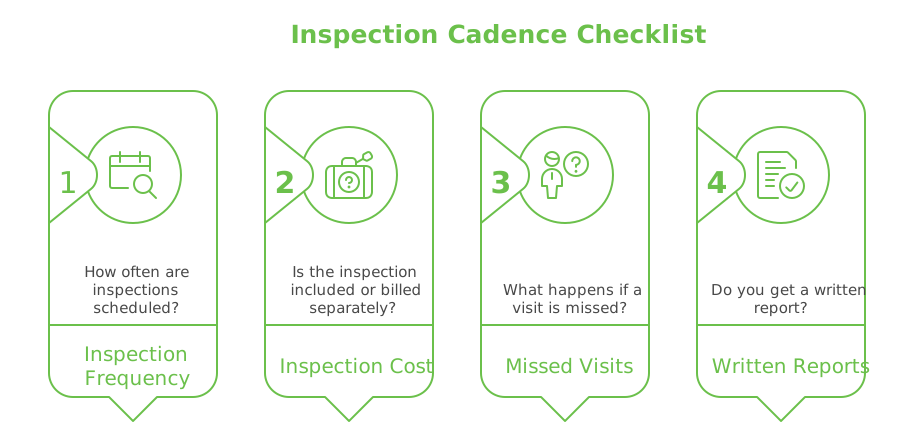
Your agreement should spell out how inspections work.
Some plans lean toward routine annual checkups. Others schedule inspections differently depending on the treatment type and the home.
A quick cadence checklist
When you’re comparing options, ask:
- How often are inspections scheduled?
- Is the inspection included or billed separately?
- What happens if a visit is missed?
- Do you get a written report?
If the provider can’t answer those clearly, that’s a sign the plan may be hard to manage later.
How to choose the right option (fast decision guide)
Here’s a simple way to match the plan to your situation.
| If you are… | A termite warranty may fit | A termite service plan may fit | What to confirm |
|---|---|---|---|
| Recently treated for termites | ✅ Yes | ✅ Maybe | Retreat rules, renewal window, inspection timing |
| Buying or selling a home | ✅ Maybe | ✅ Maybe | Transfer rules, inspection report details |
| A landlord/property manager | ✅ Sometimes | ✅ Often | Repeatable inspections, documentation, renewal process |
| “I just want peace of mind” | ✅ Maybe | ✅ Often | What’s included year-to-year, what triggers service |
If you’re torn, choose the option that makes follow-through easiest. The best plan is the one you’ll actually keep active.
See what our happy customers are saying! Read real reviews and discover why homeowners trust us.
Ready to compare your options the simple way?
If you’re in Austin and want straight answers on what your home actually needs—and what kind of termite control in Austin protection makes sense—start with an inspection and a written plan you can understand.
So, what are you waitin’ for?
FAQ
1) What has to be included in a termite warranty in Texas?
Texas consumer guidance says termite warranty information should spell out items like the coverage time period, renewal options and cost, the company’s retreat/repair obligations, and conditions tied to the owner’s action or inaction that could void the warranty (see Texas Department of Agriculture’s termite warranty disclosure guidance).
2) What’s a WDI inspection and what does the report cover?
A WDI inspection is designed to produce a report about the presence or absence of wood-destroying insects and conditions that can contribute to an infestation, plus recommendations for preventive or corrective steps when needed (as described in Texas’s WDI inspection procedures).
3) Why do termite service agreements talk so much about “conditions” and upkeep?
Termite agreements often connect coverage to ongoing conditions around the structure because termites are influenced by things like moisture and access points, and the goal is to reduce the chance of future activity (the NC Department of Agriculture’s homeowner guide to termite service agreements and warranties explains how service agreements and warranties are structured and why the written terms matter).
4) If someone says “termite bond,” what should I ask before I sign?
Ask what the bond actually includes—retreat coverage, repair coverage, inspections, renewal rules—and request the exact section in the agreement where each promise is written. Industry resources emphasize that termite management is about long-term risk reduction, so the practical value comes from the details you can verify in writing (see NPMA’s termite resources for helpful context on termite management and prevention).
5) How can I tell if two termite plans are really comparable?
Compare them using the same checklist: what triggers service, what the company will do, renewal rules, inspection cadence, transfer rules, and what voids coverage. And when you see references to rules or report standards, you can cross-check the current Texas Administrative Code section used for WDI inspection procedures to keep your comparisons grounded (Justia’s Texas Administrative Code §7.175 reference is a quick read).