If you’re building custom homes in Austin, termite protection is one of those “do it early, document it cleanly” items—especially when you’re managing termite control in Austin requirements alongside a tight build schedule. Skip the paperwork, and it can turn into a last-minute scramble.
This guide is made for custom home builders in Austin proper. We’ll cover:
-
What a pre-construction “pre-treat” is
-
When to schedule it (with a same-week mindset)
-
What documents to keep for your job folder
-
How to coordinate with your foundation and inspection timeline
We provide expert termite control across Austin, Dripping Springs, Bee Cave, Lakeway, Round Rock, Buda, and Kyle. Protect your home today!
What a “pre-treat” really means (builder version)
A pre-construction termite treatment is preventative work done before the structure is closed in, so the method can actually reach the areas termites target first—soil-to-wood pathways and hidden entry points.
Texas sets expectations around pre-construction termite treatments and how they’re applied as part of structural pest control rules. If you want the official language builders often hear referenced, it’s laid out in the state rule section on subterranean termite preconstruction treatments (Texas Administrative Code 4 TAC §7.173).
Where this fits in an Austin build schedule
Here’s the practical way to think about it:
- Pre-treats happen early (so you don’t treat over finished work)
- Documentation matters late (because closeout is when missing papers get noticed)
The City’s residential building inspection flow shows termite documentation as a closeout item collected at the final building inspection (City of Austin residential building inspection flowchart).
Builder-friendly timing checkpoints (not a headache)
Every project is different, but most custom builds follow a rhythm like this:
- Pre-slab / foundation planning: confirm your termite plan and who’s responsible for it.
- Treatment window: schedule the pre-treat for the right phase (often tied to foundation and framing milestones).
- Closeout prep: keep the documents organized so final inspection doesn’t turn into a scavenger hunt.
TDA guidance: what they expect builders to do (and keep)
When builders ask, “What does Texas want to see?” the simplest answer is: a clear plan, correct application, and clean documentation.
Texas Department of Agriculture guidance for builders emphasizes proper preconstruction planning and the importance of records and treatment details for preconstruction termite work (TDA builder guide: Proper Preconstruction Termite Treatments).
Same-week scheduling: what to send so we can lock it in
You said it best: time is money. If you want a same-week pre-treat, the fastest path is having the essentials ready before you call.
Quick-send checklist (copy/paste to your PM)
- Job address (and subdivision/lot info, if needed)
- Your target date range (2–3 options helps)
- Foundation type and current phase
- Site contact (superintendent or PM)
- Access details (gate codes, lockboxes, site hours)
- Any special notes (tight timelines, concrete pour windows, utility conflicts)
Who does what on-site
A clean pre-treat is a team sport:
- Builder: ensures access, confirms the phase is ready, and keeps the documents in the job folder.
- Pest provider: performs the treatment per label and rule expectations, then delivers the documentation you’ll need later.
Documentation builders should expect after a pre-treat
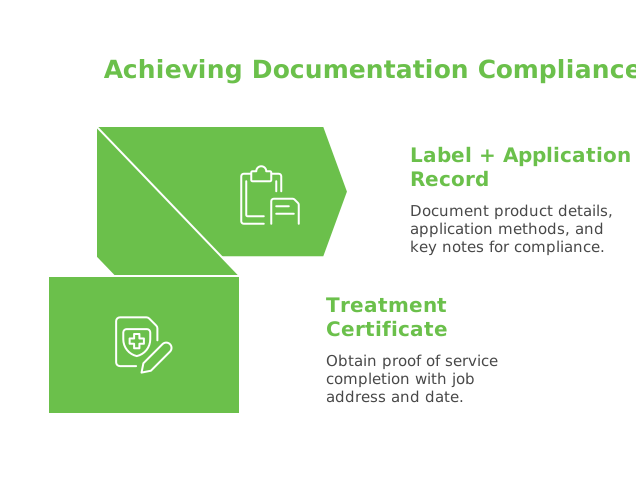
For builder coordination, keep this simple. After the pre-treat, you want documentation that’s easy to match to the address and easy to hand off.
1) Treatment certificate
Think of this as your “yes, it was done” proof for the project file. It should clearly identify the job address and the date of service.
2) Label + application record
This is the detail layer: what was used, how it was applied, and the key record notes you keep for compliance and future reference.
Texas A&M AgriLife provides a practical overview of termite rules and product considerations for Texas, which helps builders understand why the “label + application record” piece matters (Texas A&M AgriLife termite rules overview).
Common builder slip-ups that cause delays
No judgment—every builder has been there. These are the usual culprits:
- Scheduling too late for the phase (then the crew is waiting)
- Site not ready (no access, wrong phase, poor visibility)
- Docs scattered across emails, texts, and job folders
- Final inspection week panic because paperwork can’t be found
A simple fix: keep a “Termite” tab in your job folder from day one and drop the certificate and records in the moment you get them.
Builder coordination tips that save you time
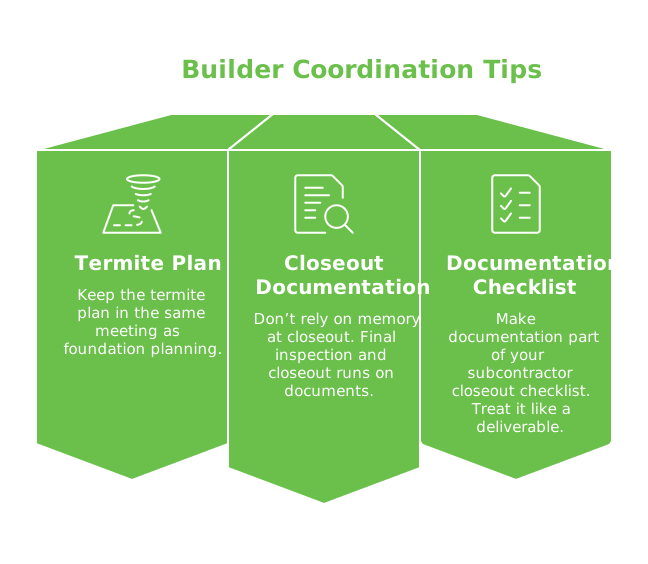
Keep the “termite plan” in the same meeting as foundation planning
If it’s not on the agenda, it tends to show up later—usually when you don’t want it.
Don’t rely on memory at closeout
Even if everyone knows the treatment happened, final inspection and closeout runs on documents.
Make documentation part of your subcontractor closeout checklist
Same as warranties and manuals—if it’s required for the project file, treat it like a deliverable.
Quick decision table: what do you need, and when?
| Builder scenario | What to schedule | What to keep | When it matters most |
|---|---|---|---|
| New custom build | Pre-construction termite treatment | Certificate + label/application record | Final inspection / closeout |
| Tight timeline | Same-week pre-treat coordination | Same docs, filed immediately | Prevents last-minute delays |
| Handoff to owner | Clean job-folder documentation | Copies for owner + builder file | After closeout |
See what our happy customers are saying! Read real reviews and discover why homeowners trust us.
Ready to keep your build on track?
If you’re on a tight construction timeline, the last thing you need is a termite pre-treat that slips or paperwork that goes missing right before closeout. Get ahead of the schedule with same-week coordination, clear documentation, and everything filed correctly from day one.
Book builder support with Termite Control Austin and keep your project moving without last-minute surprises.
FAQ: Austin pre-treats for custom home builders
1) How early should I schedule a termite pre-treat on an Austin custom build?
If you want same-week scheduling, plan it as soon as your foundation timeline is firm. Pre-treats work best when they’re tied to the right construction phase, not squeezed in after the fact.
2) What paperwork should I keep for my builder job folder?
Keep two items together: your treatment certificate and the label + application record. When those are filed cleanly, closeout is smoother and you’re not digging through old emails.
3) Where does Austin typically check termite documentation?
Austin’s inspection flow treats termite documentation as a closeout item collected at final inspection, so it’s smart to keep it ready before your final week.
4) Does a pre-treat replace a future termite inspection?
They’re different tools for different moments. A pre-treat is preventative work during construction, while inspections are used to assess conditions and activity at a point in time.
5) Can BrockStar coordinate pre-treat timing with my superintendent?
Yes. BrockStar works with builders on scheduling and coordination and provides the documentation you need for the job file.